The QA cycle, arguably the most human part of any company, is necessarily human. Right?
Anybody properly using autonomous AI delivery right now, knows the bane of the QA layer.
In 2025 and 2026 many engineers reported longer QA cycles implementing autonomous AI delivery (1)(2)(3).
My experience was exactly the same.
Which is why;
“AI should be applied at the human layer before the product layer”
What is Autonomous AI delivery?
Any company, individual or agent using AI to go from prompt to product without human intervention is using autonomous AI delivery.
This is not vibe coding.
It is typically done in the cloud using sophisticated “data” and “context” loops between AI agents.
Many engineers have spent most of 2025 and 2026 trying to find the best engineering loop.
Current solutions have a severe weakness embedding into modern organizations, the QA layer.
Because traditionally QA is a human entity in business.
Autonomous AI delivery removes humans from the loop.
What is Artificial Intelligence - AI?
Any system that has intelligence not of biological origin.
Are mainstream LLMs intelligent (ChatGPT, Claude, Gemini)? Maybe.
Some say yes (5). Others say not yet (7)(8)(10).
The verdict is still undecided.
My opinion after 24 months? Mainstream AI is not human intelligence.
In 2026 AI is not more “intelligent” than you. But it will “know” more than you and I ever will.
The way your company uses AI defines what it is for you.
Vibing, assistive, autonomous, RSI all quite different.
It is safe to think of mainstream AI as an exceptionally large knowledge source (6) capable of speaking in any language to communicate at speeds that would make special relativity proud.
What is Recursive self-improvement - RSI?
Medical terminology for arthritis? No.
It is a new application of AI that recursively self-improves toward a defined goal.
100x more powerful than the LLM you used today.
One day it will probably solve medical RSI (if it has not already).
Here is an article describing it well (4) (9).
RSI has large computational dependencies. The kind with many billions invested.
There is no one way to implement RSI. The goal and problem space matters.
Computational dependency changes across the problem space and goal.
It can be applied to;
Workflows – Recursively learn worker habits, strengths.
Robotics – Recursively learn the home environment.
Code testing – Recursively improve test coverage
The list goes on … it’s AI that gets incrementally better over time.
What should we apply AI and RSI to?
Everything?
Please remember there are finite resources and compute on Earth, despite what tech valuations have led us to believe.
AI can be pointed at many layers of business. Two popular right now. The product layer as implied earlier is where AI produces the output itself. The human layer is where AI makes the person producing the output much better.
Spending the last 24 months building and using AI in my professional and personal life I believe AI outcome boils down to present cost across relative impact.
Outcome can be measurably revolutionary, until everyone adopts the same solution, in similar time, because everyone is using AI the same way toward the same problem.
Trivializing impact at the absolute present cost you paid. Wasting time and resources.
Keeping leverage and futures markets very honest.
Cutting 100,000 jobs is not a successful application of AI technologies.
It may be necessary for other means. But it is not a measured application of AI.
The large present human capital cost in an unrealized futures market, is unsafe.
The same technology can be used to transform those same 100,000 people.
Said another way;
AI technology applied at the product layer likely derives a convergent market position.
Whilst applied to the human layer likely derives a divergent one.
Divergent thinking creates markets; convergent thinking restricts markets.
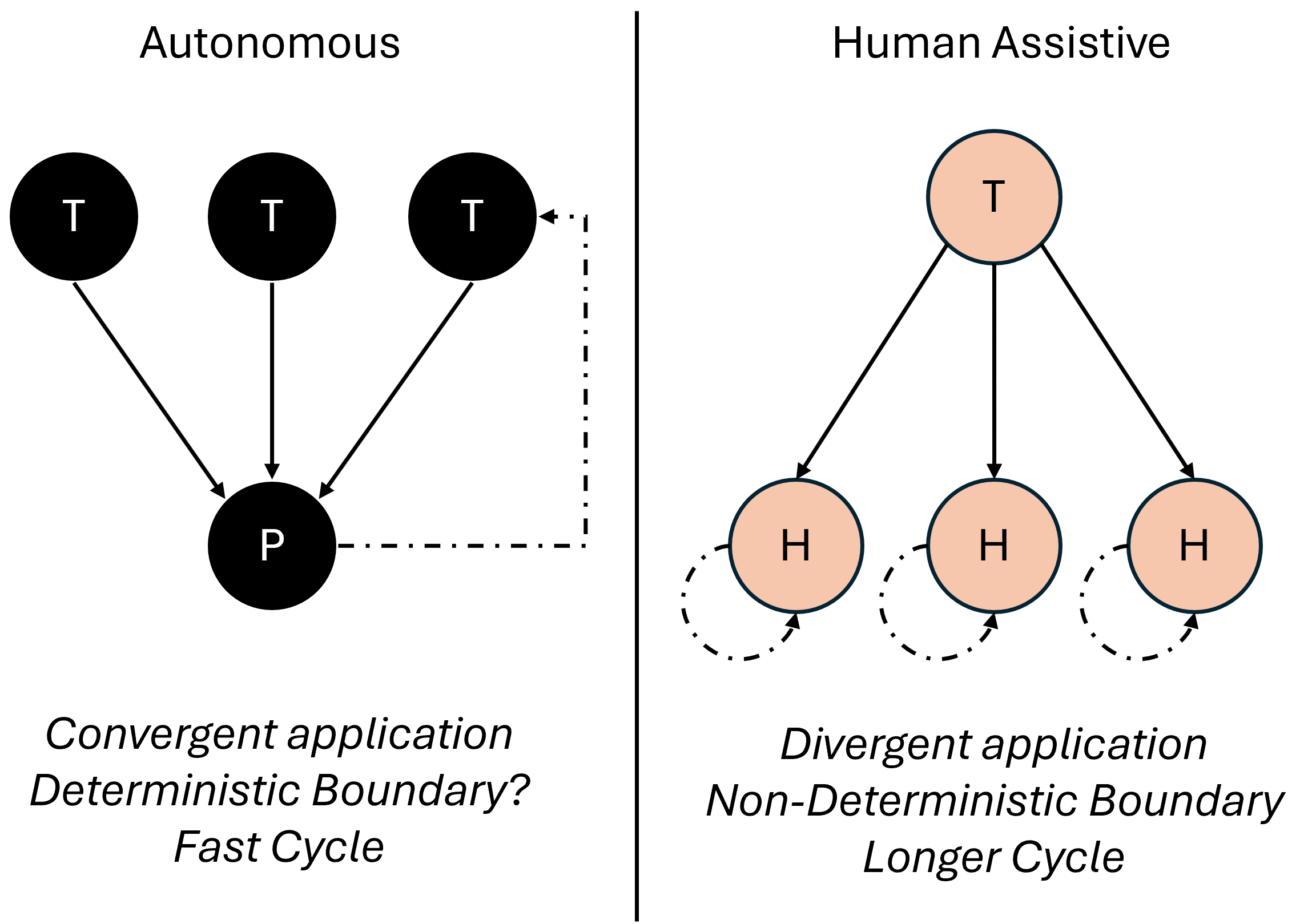
Consider AI/RSI technology T as at left. RSI loop = dotted lines.
Applied at the product layer (left) one could argue this is convergent about a deterministic boundary. P applications (goals).
Applied at the human layer (right) it will no doubt be multiplicative. Having a higher degree of non-determinism. H applications (goals).
Product cycle times may be longer at right, but quality is still proportional to a QA cycle. The system at right has a faster QA cycle.
The diagram is a simplification for demonstration purposes.
Ultimately, I think AI and RSI will be applied across every industry and all verticals. Meaning we will get the negative with the positive.
What we should apply AI to is where we can accept present cost across relative impact.
I believe now is a time of market creation.
RSI / AI and Recursion
When considering what where we apply RSI, we must understand recursion.
Recursion is a loop that repeatedly executes the same or very similar logic until a goal is met.
It can be applied to destructive or productive goals.
A safe application of RSI is one that measures risk and validates recursive loops.
The recursive part is unsafe when misunderstood.
Software engineers know the dangers and power of recursion.
Control the loop. Don’t get the logic (math) wrong! No, not even a little bit!
Code level recursion works because what can go wrong is either fully controlled (or accepted) and/or the logic is absolutely understood.
Consider though, recursion applied across a complex problem space…
What is the probability we can entirely understand that problem space to safely recurse?
Small, approximating to 0 over time.
The broader the problem space the more inaccuracy.
RSI goals must be feasibly reachable in the problem space. Cost, logic and impact across those goals must be understood.
Prove the technology atomically first before complexity.
Human workflows are a great starting point and highly atomic.
The human or product layer
Most businesses moving into 2027 are facing a choice. To cut head count in favor of AI gains, or not.
For some businesses this is unavoidable and AI truly does bring strong efficiency gains entirely trivializing some work.
However, I challenge that same business to ask whether those gains are truly more efficient than the same technology applied at the human layer.
Consider how AI has already transformed learning.
Consider how AI can embed across workflow layers to drive divergent thinking, quality and creativity.
In what amount of time can your 10-year engineering vet learn, or pivot skills?
Quality is inherently a human concept. Not at all artificial.
AI applied at the product layer tends to overlook this.
I am not sure the human could ever be removed from the QA loop.
I believe AI applied at the product layer is convergent thinking.
Because, if every business does it, they accept a training boundary deriving marginally different products at best.
Straining distribution with the same quality product.
The best businesses will apply AI to both the human and product layers, doing both well.
But doing one well is the first step. You should choose the human layer first, your QA team will thank you.
The human layer enables productivity gains your QA team can manage.
The product layer might create a growing black box for your QA team.
Applying AI at the human layer is not AI that completes work for the employee.
It is allowing humans to derive atomic AI benefit so they can attribute time toward tasks they are not confident AI can do.
When your human QA layer cannot tell the difference and productivity improves its working well.
$20 Claude Pro subscriptions can already do this on a basic level with impressive results.
Like anything though, quality matters. That’s where the game is.
In 2027 RSI that assists human workflows will be foundationally transformative.
AI workflow assistants empowering teams and individuals, rather than replacing them, are problem spaces RSI should reach for first. Which should have positive impact at acceptable present cost.
Good luck with your AI strategy in 2027!
(1) Faros AI. (2026). AI Engineering Report 2026: The Acceleration Whiplash. Faros AI. https://www.faros.ai/research/ai-acceleration-whiplash
(2) Faros AI. (2025, July 23). The AI Productivity Paradox: AI coding assistants increase developer output, but not company productivity. Faros AI. https://www.faros.ai/ai-productivity-paradox
(3) Chen, F., & Stratton, J. (2026). Artificial intelligence in the firm: Bottlenecks in software production [Working paper]. Harvard University. https://fion.ac/jellyfish.pdf
(4) Crescendo. (n.d.). What is self-improving AI? A plain-English guide to recursive self-improvement. Crescendo. https://www.crescendo.ai/blog/self-improving-ai
(5) Chen, E. K., Belkin, M., Bergen, L., & Danks, D. (2026, February). Does AI already have human-level intelligence? The evidence is clear. Nature, 650(8100), 36–40. https://doi.org/10.1038/d41586-026-00285-6
(6) Lindsey, J., Gurnee, W., Ameisen, E., et al. (2025, March 27). On the biology of a large language model. Anthropic. https://transformer-circuits.pub/2025/attribution-graphs/biology.html
(7) Lewis, M. & Mitchell, M. (2025). Evaluating the Robustness of Analogical Reasoning in Large Language Models. TMLR. https://arxiv.org/abs/2411.14215
(8) ARC Prize Foundation. (2026). ARC-AGI-3: A new challenge for frontier agentic intelligence. arXiv. https://arxiv.org/abs/2603.24621
(9) Zhang, J., Hu, S., Lu, C., Lange, R. & Clune, J. (2026). Darwin Gödel Machine: Open-Ended Evolution of Self-Improving Agents. ICLR 2026. https://arxiv.org/abs/2505.22954
(10) Daily Nous (2026). Is Artificial General Intelligence Here? https://dailynous.com/2026/02/02/is-artificial-general-intelligence-here/
(11) Kwa, T. et al. (2025). Measuring AI Ability to Complete Long Tasks. METR. https://arxiv.org/abs/2503.14499
